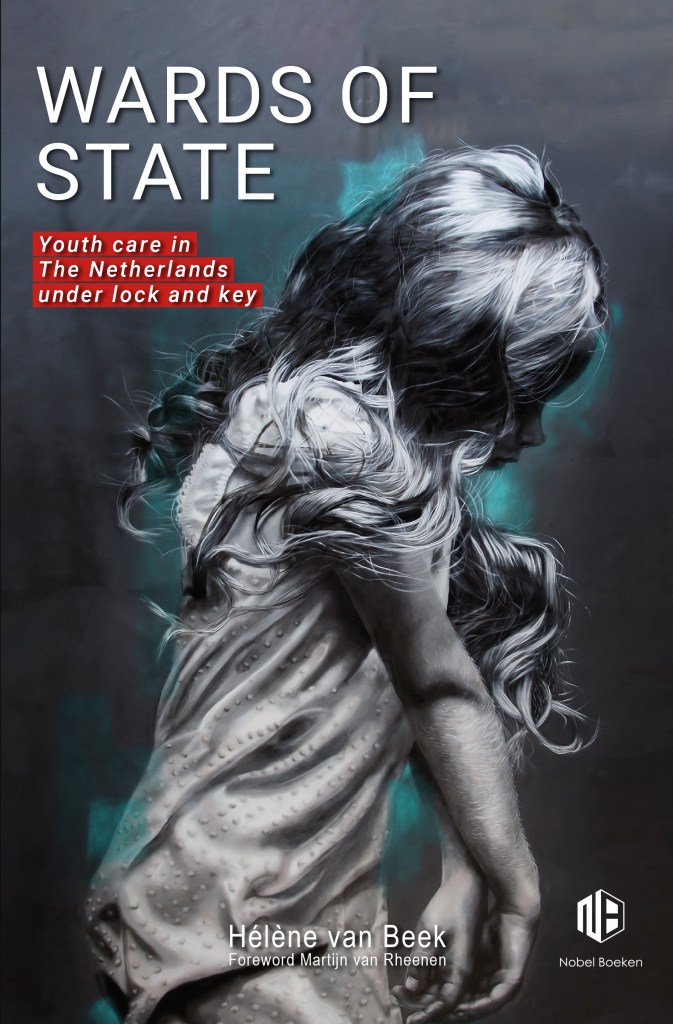
Wards of State. Youth care in the Netherlands under lock and key
In honour of the author Hélène van Beek
This is the English translation of the Dutch book on youth care that was published in 2020 under the title ‘Kinderen van de Staat.[1] The translation is mainly intended for readers in Europe and also a tribute to the journalistic work of the author Hélène van Beek (1964–2022).
Hélène van Beek worked as an investigative journalist, and was a member of the VVOJ (Dutch association of investigative journalists). She worked for Dutch daily newspapers (e.g. Trouw) as well as for the television shows Zembla and ‘Witteman Ontdekt’ (VARA television). From 2010 onwards, she made reports for Argos (investigative journalism VPRO radio) and before that she reported for daily newspaper ‘De Gelderlander’ for 18 years. Van Beek studied contemporary history and press history at Radboud University Nijmegen, after which she took a postgraduate course in journalism for academics. She worked on this shocking publication for three years, while consulting the current literature, interviewing many young people and their parents, as well as experts in youth care, juvenile lawyers and judges. Through many requests for information under the Government Information (Public Access) Act (WOB), she uncovered secret information and even more shocking were the parts that had been redacted. After investigating tenders in the youth care market — it is a market — shady practices came to light and, as it turns out, profits take precedence over the welfare of young people. Meanwhile, several scandals as described in this book have also been made public and are being discussed in the political arena.
[1] H. van Beek, Kinderen van de Staat. Jeugdzorg in ademnood (Baarn, Nobel Boeken 2020)
From the publisher
In the Netherlands, minors who are under state supervision or have been placed out of home at the order of the courts are what is known as Wards of State. The research project and book were the initiative of Martijn van Rheenen, entrepreneur and himself an experience expert on being a youth care child. The research concerns the situation since the system changed in 2015. All the abuses and cases identified over the last eight years are still current. Even more so than ever, because abuses tend to accumulate and government oversight and control from 2015 onwards are completely lacking. Irrespective of their type of problem, adolescents are not safe from the Dutch state.
As a result, this is not a ‘nice’ book, but rather one filled with injustices (‘zwartboek’). The book provides a large amount of clarity on the state of affairs in Dutch youth care. A string of harrowing cases show how major and gross mistakes are being made at every stage of youth care in the Netherlands; from the initial assessment of a certain situation, to the lack of proper psychiatric diagnosis regarding the children involved, to the too-rapid out-of-home placement of children, separating them from their parents and usually also from siblings in cases where these are placed in different facilities. These children end up in market organisations that are focused on making a profit. By the time they are 18, they are no longer wards of state and are released out on to the streets — with nothing: their family ties often destroyed, homeless and without any help.
In the Netherlands, more children end up in foster homes or care institutions than anywhere else in the world. The Netherlands is the ‘champion’ of out-of-home placements and closed care admissions of children. Every year, around 3,000 children are admitted to a closed youth care facility, under the regime known as JeugdzorgPlus. Institutions that could effortlessly double as prisons. The number of out-of-home placements, currently at 46,000, have increased rather than decreased. According to data from only a few years ago, in the Netherlands, around 420 children for every 5 million inhabitants were being admitted to closed care facilities. In Denmark, a comparable country, this was only 5 children per 5 million inhabitants, while in Belgium this was 15 per 5 million and in Germany 80 per 5 million. Since then, the Dutch numbers have only increased. This score is not slightly worse, it is a great deal worse. The Netherlands tops Europe in terms of numbers of adolescents in closed facilities. The youth care supervisory board has already proclaimed, loud and clear, that it lacks the capacity needed to exercise adequate supervision. As a result, more and more children are finding themselves under lock and key by order of the court and are quite literally the ones paying the price. Children’s rights are systematically being violated, in all possible ways: the right to family, the right to mental and physical health care, the right to disability care, the right to carry their family name, the right to equality, the right to a healthy life, the right to physical exercise and recreation, the right to education, the right to an opinion, the right to protection from abuse and violence, and the right to healthy food.
The Dutch version of this book found its way to all the ministries involved, and to all the MPs with youth care in their portfolio. The book featured during hearings in the Dutch House of Representatives. With the cooperation of the foundation ‘Het Vergeten Kind’ [the forgotten child, ed.], all Dutch municipal council members — close to 8,000 local politicians — received a free e-book copy. A second edition was issued that same year and book sales continued in the years that followed; and the book was also used in youth care teaching courses, amongst other things.
In the NOS news broadcast of 12 June 2019, the Committee investigating violence in youth care [Commissie Onderzoek naar Geweld in de Jeugdzorg], led by Micha de Winter, presented its report in 3 volumes and 16 appendices, totalling close to 3000 pages. Its conclusion: 75% of children in youth care have been subjected to physical, mental or sexual violence.[1] Parliament acknowledged the report’s findings and, not for the first time, proclaimed to be ‘shocked and astounded’. In recognition of the problem, the government came up with the simplest of solutions: all children who were a victim of violence or abuse while they had been a ward of state were to receive EUR 5,000.
Thus, over the past two years (2021–2022), under this two-year government compensation scheme, intended for the thousands of children in youth care who had suffered abuse, while others had been compelled into forced labour, over 20,000 victims of sexual abuse in youth care have applied for financial compensation. Maltreatments took place at both foster homes and care institutions. The amount of five thousand euros was meant as an initial compensation for the victims.[2] This money, however, will not fix the trauma suffered in youth care. Since the liberal policies of the past decade, the Dutch Government seems to knows the price of absolutely everything and the value of next to nothing.
Bureaucracy is stifling youth care. ‘Organised Impotence’ is both the title and the conclusion of a report by the Netherlands Court of Audit, the auditor of government spending. No one is taking the lead to get the youth protection system on the right track again, none of those involved are working on a solution, all parties are pointing to each other. Youth protection in the Netherlands is not functioning because of such organised impotence. The Court of Audit has stated it has no confidence in the Dutch Cabinet’s reform plans. In practice, services and government authorities fail in implementation — and, thus, government ministers also fail. After all, they are responsible for the functioning of the ecosystem within which municipalities, youth protectors, children’s judges, care providers, the Child Care and Protection Board and Veilig Thuis [Dutch aid organisation on domestic violence and child abuse, ed.] have to arrange the care for the Netherlands’ most vulnerable children.
Unfortunately, there are also other things going wrong in the Netherlands, things that, once again, result in children being the victims. There was the scandal of the Dutch Tax and Customs Administration keeping a blacklist — which is against the law. Hundreds of thousands of citizens and companies unknowingly ended up on those lists, including close to 2,000 children! These blacklists from the tax department were related to fraud. This could be actually detected fraud but also merely a suspicion of fraud. A person could become blacklisted by an anonymous tip, after which the tax department would reclaim one or more years of child benefit payments, often unfounded. It is estimated that the government ordered nearly 2,000 children to be removed from their parental homes, as a result of around 60,000 families having been blacklisted due to the impact of stress and the poverty trap. Supposedly ‘for the good of the children’ and because parents were powerless to do anything about it.
Even worse, the government was aware of these abuses and, for years, lied about it to the House of Representatives. This scandal only came to light thanks to the intensive ‘detective work’ by two MPs, Renske Leyten and Pieter Omtzigt. MP Pieter Omtzigt, who is also the recent founder of the new political party ‘Nieuw Sociaal Contract’ [new social contract, ed.] characterised the issue as follows, in the House of Representatives: ‘The Netherlands is a banana monarchy’. In a lecture in Nieuwpoort, the Dutch parliamentary news centre, he stated: ‘The Dutch Tax and Customs Administration has structurally violated 13 laws, and probably many more — you should try that! This may land citizens in a Kafkaesque situation. I cannot stress enough how disastrous it is in a constitutional state if one of the strong arms of government (tax department, police, army) structurally and unabashedly is breaking the law.’[3] Things could be worse, Pieter Omtzigt concluded: ‘The children who were placed out of home in the context of the ‘social security supplements scandal’ [toeslagenaffaire, ed.] could not be traced or contacted because of the EU General Data Protection Regulation (GDPR). The law was changed only very recently, for this purpose, a process that took place excruciatingly slow. When we look at who the personal data of the people affected by this scandal were shared with, this is truly a scandal in itself: here, the government seems to be mostly protecting itself, hiding behind the GDPR. Because if a child had been placed out of home for a certain period of time — often after only one year —the outlook was that it would not be returned to its parental home. To then wait for yet another 1.5 years to provide help is downright bizarre.’
Foundation ‘Justice Wards of State’
For the many current abuses in youth care, justice must be obtained elsewhere. If not via Dutch law, then through the European Union and EU law. The rights violations must be addressed at the highest national political and legal level. If that fails, EU law needs to provide the solution. This English edition is intended as a basic dossier and to communicate the facts to the European Community.
Where to start? Achieving any real impact requires something more drastic than poking a few fingers at a petrified system in which many people are trying their best but are bound hand and foot by impossible rules, flawed functionalities and an overwhelming amount of bureaucracy. Where politics and national government have failed— not for the first time in 21st century Netherlands, there is only one tried and tested way of pursuing justice: the courts. It is that kind of solution towards which the initiator of Wards of State, Martijn van Rheenen, and the Nobel Books publisher intend to work. In line with this, a separate charitable support foundation has been established to fund the necessary legal costs and to ensure that, by law, every child facing youth care is assigned a lawyer: ‘Stichting Recht Kinderen van de Staat’ [i.e. the rights of wards of state; http://www.justicewardsofstate.eu).
Before going to the European Court of Justice (ECJ), the plan arose to first start national litigation proceedings directly against the Dutch Government for the most distressing issues, such as the heartlessly long waiting lists, the lack of adequate treatment, the arbitrary out-of-home placements and, in particular, the court-ordered supervision (OTS). The OTS is one of the most harrowing measures for any child and parent: family ties are cut, parents are given a few hours of visitation per year, children are alienated from their parents. Children are often traumatised by the time they are released from youth care, which is on the day they turn eighteen.
There is also another legal instrument available, namely that of exercising the right of complaint — for example, to the European Court of Human Rights (ECHR). In such a case, it would be the Dutch Government on the witness stand, rather than some defenceless children.
In order to successfully present such cases, the Netherlands fortunately has a corps of juvenile lawyers. Co-director of the foundation ‘Justice Wards of State’, Reinier Feiner, is also chairman of the Dutch association of cause lawyers [Vereniging Sociale Advocatuur Nederland (VSAN)] and board member of the association of juvenile lawyers in Rotterdam (Vereniging Jeugdrecht Advocaten Rotterdam (VJAR)). That is where the relevant lawyers will have to be found who will, for example, be able to hold children’s judges accountable.
The book that is now before you is essentially a cry for help, for Europe to break the rigidity of Dutch politics, the clique of civil servants and the bureaucracy of a failing market. The content of this book unfortunately remains current. The stories and analyses are not mere incidents but are routine occurrences in a process that continues to break children and their family ties, and has been doing so for decades.
Rob Bakker, publisher Nobel Boeken/Nobel Books
info:
http://www.justice-wards-of-state.eu
wwwrechtkinderenvandestaat.nl (Dutch)
[1] De Winter Committee, ‘Onvoldoende beschermd – Geweld in de Nederlandse jeugdzorg van 1945 tot heden’, (The Hague, 2019)
[2] NOS, 1 January 2023.
[3] Herstel van de machtsbalans, Lecture ‘Binnenhoflezing 2023’, Pieter Omtzigt, 6 September 2023.
 Stichting Nobel